

Many patients ask us some version of the same question after we recommend a biopsy.
“You found something in my mouth. Does that mean it’s cancer?”
In practice, that fear is the most common reaction, and it’s almost always more frightening than the reality. The large majority of oral tissue biopsies come back benign. But a biopsy is the only way to know for certain, and that certainty is exactly why your dentist recommends it.
However, not knowing what to expect- the procedure itself, the recovery, or how long results take makes the wait feel worse than it needs to. This guide walks through the full picture.
Direct Answer: An oral tissue biopsy is a minor procedure where a small sample of tissue is removed from the mouth, gums, tongue, cheek, lip, palate, or floor of the mouth and sent to a lab for microscopic examination, a field called oral pathology. It’s typically recommended when a sore, lump, or unusual patch hasn’t healed within two to three weeks. Most biopsies take under 30 minutes with local anesthesia, recovery takes a few days to a week, and results usually return within one to two weeks.
In this article, we’ll cover when a biopsy is recommended, the different types of oral biopsy procedures, what to expect during and after, and how to understand your results once they come back.
Executive Summary
- An oral tissue biopsy removes a small sample of mouth tissue for microscopic examination to diagnose the cause of a persistent sore, lump, or unusual patch.
- Dentists typically recommend a biopsy when a lesion hasn’t resolved within two to three weeks on its own, since that persistence is what separates a minor irritation from something that needs investigation.
- There are several types of oral biopsy procedures: incisional, excisional, brush, and fine-needle aspiration, and the right one depends on the size, location, and appearance of the area in question.
- Most oral biopsies are done in-office under local anesthesia and take well under an hour, with only mild soreness afterward.
- Recovery is usually a few days to a week, and most patients return to normal eating and speaking within a few days.
- Results generally take one to two weeks, and the majority of oral biopsies come back benign, meaning non-cancerous.
What Is an Oral Tissue Biopsy?
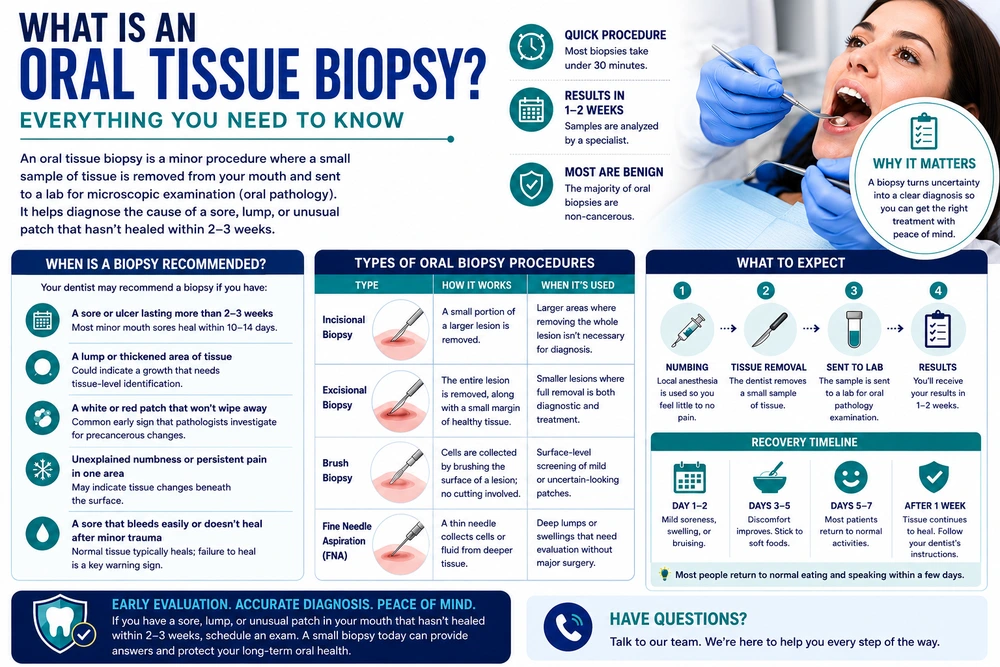
An oral tissue biopsy is a procedure where your dentist removes a small piece of tissue from an area of concern in your mouth and sends it to a lab. There, a specialist trained in oral pathology, the study of diseases affecting the mouth, examines the sample under a microscope to identify exactly what’s happening at a cellular level.
This can be done on the gums, tongue, inner cheeks, lips, roof of the mouth, or floor of the mouth. The goal is straightforward: turn an uncertain visual observation into a definitive answer. Without a biopsy, it’s very difficult to know for certain whether a suspicious area is harmless or something that needs treatment.
When Is an Oral Biopsy Recommended?
Your dentist typically recommends a biopsy after noticing something during a routine exam or oral cancer screening that doesn’t resolve on its own. The most common triggers are:
| Finding | Why It Raises Concern |
| A sore or ulcer lasting more than 2-3 weeks | Most minor mouth sores heal within 10-14 days on their own |
| A lump or thickened area of tissue | Could indicate a growth that needs tissue-level identification |
| A white or red patch that won’t wipe away | Common early sign that pathologists investigate for precancerous changes |
| Unexplained numbness or persistent pain in one area | May indicate tissue changes beneath the surface |
| A sore that bleeds easily or doesn’t heal after minor trauma | Normal tissue typically heals; failure to heal is a key warning sign |
If you notice any of these and it hasn’t improved within two to three weeks, it’s worth having it evaluated, even if it feels minor.
Types of Oral Biopsy Procedures
Not every oral biopsy is done the same way. Your dentist chooses the method based on the size, location, and appearance of the area.
| Biopsy Type | How It Works | When It’s Used |
| Incisional biopsy | A small portion of a larger lesion is removed | Larger areas where removing the whole lesion isn’t necessary for diagnosis |
| Excisional biopsy | The entire lesion is removed, along with a small margin of healthy tissue | Smaller lesions where full removal is both diagnostic and treatment |
| Brush biopsy | Cells are collected by brushing the surface of a lesion; no cutting involved | Surface-level screening of mild or uncertain-looking patches |
| Fine needle aspiration (FNA) | A thin needle collects a small tissue or fluid sample | Lumps beneath the surface, such as swollen glands or deeper masses |
What Happens During an Oral Biopsy Procedure
Most oral biopsy procedures follow a similar pattern, whether they’re done by your dentist or a referred oral surgeon.
Numbing the area. Local anesthesia is applied first, so the area being sampled is fully numb before anything is removed. Most patients feel pressure, not pain.
Removing the sample. Depending on the biopsy type, your dentist either removes a portion of tissue or the entire lesion, brushes the surface, or draws a sample with a fine needle. This typically takes just a few minutes.
Closing the site. For incisional or excisional biopsies, a stitch or two is often placed to help the area heal. Brush biopsies and FNA usually don’t require any closure.
Sending the sample to the lab. The tissue is preserved and sent to an oral pathology lab, where it’s processed, sliced, stained, and examined under a microscope by a specialist.
The entire in-office portion of the procedure is typically done in under 30 minutes.
Oral Biopsy Recovery Time and Aftercare
| Timeframe | What to Expect |
| First 24 hours | Mild swelling and soreness at the site, manageable with over-the-counter pain relievers |
| 2-3 days | Soreness gradually improves; stitches (if placed) remain in place |
| 5-7 days | Most patients are back to normal eating and speaking |
| 7-10 days | Dissolvable stitches typically resolve on their own if used |
To support healing, stick to soft foods for the first day or two, avoid spicy or acidic foods that can irritate the site, rinse gently with warm salt water starting the day after the procedure, and avoid smoking or using straws, both of which can disrupt healing. Mild swelling and tenderness are normal; a cold compress on the outside of the cheek can help the first day.
Understanding Your Oral Biopsy Results
Results typically take one to two weeks to come back from the lab, though this can vary depending on the lab’s workload and whether additional staining or testing is needed. When your results come back, they will generally fall into one of a few categories:
| Result Type | What It Means | Typical Next Step |
| Benign | No abnormal or cancerous cells found | Often no further treatment needed, though follow-up monitoring may be advised |
| Precancerous (dysplasia) | Abnormal cells present that could develop into cancer over time | Close monitoring, and sometimes removal of the affected area |
| Malignant | Cancerous cells identified | Referral to an oral surgeon or oncologist for staging and treatment planning |
| Inconclusive | The sample didn’t provide enough information for a clear diagnosis | A repeat biopsy may be recommended |
It’s worth repeating: the majority of oral biopsies come back benign. A biopsy being recommended does not mean cancer is likely; it means your dentist wants a definitive answer rather than a guess.
Is an Oral Biopsy Painful?
Most patients describe the procedure itself as more uncomfortable than painful, thanks to local anesthesia. The days after tend to feel similar to a canker sore or minor cut in the mouth, noticeable but manageable with over-the-counter pain relief. Significant pain, spreading swelling, or fever after the procedure isn’t typical and should prompt a call to your dentist.
Oral Biopsy: Myths vs Facts
| Myth | Fact |
| A biopsy means your dentist thinks you have cancer. | A biopsy is recommended to get a definitive answer; most come back benign, not because cancer is suspected or likely. |
| Oral biopsies are a major surgical procedure. | Most are minor, in-office procedures done under local anesthesia in under 30 minutes. |
| Recovery takes weeks. | Most patients return to normal eating and speaking within about a week. |
| All oral biopsies are done the same way. | The method, incisional, excisional, brush, or fine-needle aspiration, depends on the size, location, and appearance of the area. |
| If a sore doesn’t hurt, it doesn’t need to be checked. | Painless sores, patches, and lumps can still be significant. Persistence beyond 2-3 weeks matters more than pain level. |
What Should You Do? A Quick Reference
| Your Situation | Recommended Action |
| A mouth sore or ulcer that’s lasted less than 2 weeks | Monitor it. Most minor sores heal on their own within 10-14 days |
| A sore, lump, or patch that’s persisted more than 2-3 weeks | Schedule an evaluation; a biopsy may be recommended |
| Your dentist has already recommended a biopsy | Ask which type is planned and what recovery to expect, then schedule it promptly |
| You’re waiting on biopsy results | Results typically take 1-2 weeks. Call the office if it’s been longer without an update |
| You received a benign result | Continue routine checkups and mention any new or recurring areas at future visits. |
Final Thoughts
A biopsy recommendation can feel alarming, but it’s a routine, well-established step that gives you and your dentist a clear answer instead of a guess. Most results are reassuring, and even when they’re not, catching something early gives you the best possible starting point for treatment.
Have a Sore or Lump That Hasn’t Healed?
If you’ve noticed a sore, lump, or patch in your mouth that hasn’t gone away in two to three weeks, don’t wait on it. Call Eagle Falls Dentistry at (630) 894-5180 or 630-755-6852, or schedule an appointment online. We’re located at 76 Stratford Drive, Bloomingdale, IL 60108.
Frequently Asked Questions
What is an oral tissue biopsy?
An oral tissue biopsy is a procedure where a small sample of tissue is removed from the mouth and examined under a microscope by an oral pathology specialist to diagnose the cause of a sore, lump, or unusual patch.
What is oral pathology?
Oral pathology is the field of dentistry focused on diagnosing diseases that affect the mouth, jaws, and surrounding tissues, often through microscopic examination of biopsy samples.
Is a mouth biopsy painful?
Most patients feel pressure rather than pain during the procedure, since the area is numbed with local anesthesia first. Mild soreness for a few days afterward is normal and manageable with over-the-counter pain relievers.
What does the oral biopsy procedure involve?
The procedure involves numbing the area, removing a tissue sample (through incisional, excisional, brush, or fine needle aspiration methods), sometimes placing a stitch, and sending the sample to a lab for microscopic analysis.
How is a biopsy of mouth tissue different from a regular dental exam?
A regular dental exam is visual and doesn’t involve removing tissue. A biopsy of mouth tissue involves physically sampling the area so it can be examined under a microscope, which provides a definitive diagnosis that a visual exam alone cannot.
What is the oral biopsy recovery time?
Most patients experience mild soreness for the first few days, with a return to normal eating and speaking within about 5 to 7 days. Stitches, if placed, typically resolve on their own within 7 to 10 days.
How long do oral biopsy results take, and what do they mean?
Results typically take 1 to 2 weeks. They generally fall into benign (no abnormal cells), precancerous (abnormal cells that need monitoring), or malignant (cancerous cells requiring further treatment). Most oral biopsies come back benign.