

A missing tooth forces your mouth to adapt in ways you don’t consciously register. Your tongue shifts position. Your jaw alters its biting pattern. Adjacent teeth lean into the space. Bone under the missing tooth begins resorbing because there’s no longer a root to stimulate it. These changes compound over months.
The goal of replacing a missing tooth isn’t purely aesthetic. It’s about preserving your ability to eat normally, maintaining jaw alignment, preventing adjacent teeth from shifting, and stopping the bone loss that makes your face look older over time.
Two primary options exist: a bridge or an implant. Each solves the problem differently with distinct advantages and limitations. Understanding those differences allows you to make an informed decision based on your specific situation.
Bridge vs Implant: The Fundamental Difference
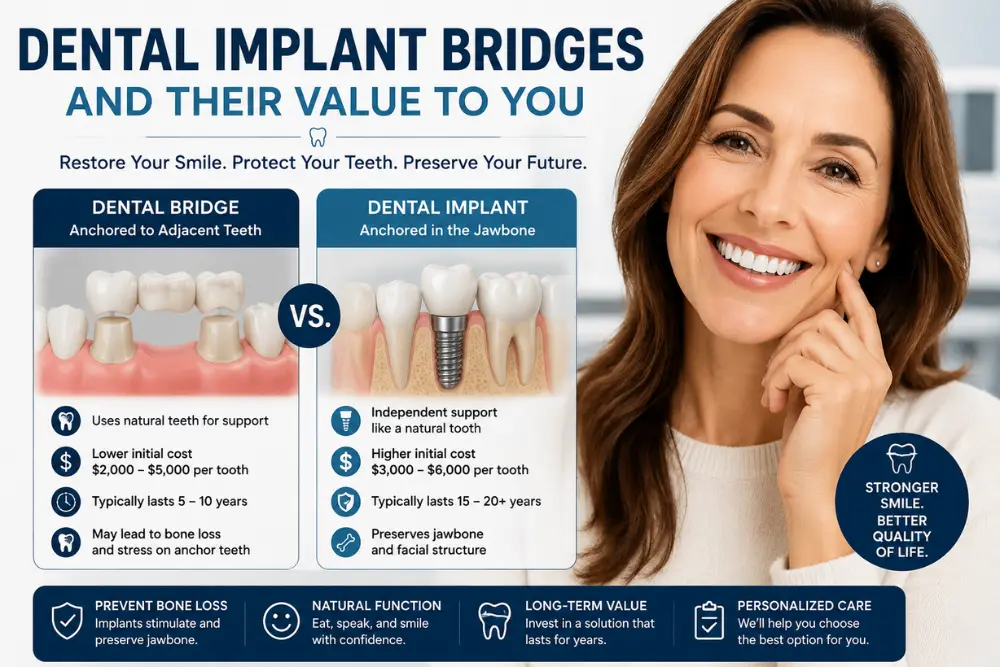
A bridge is a false tooth anchored to adjacent teeth. Your dentist grinds down the surrounding teeth, removes the dead nerve (root canal), and places crowns on them. The bridge spans the gap, suspended between these two anchored crowns. It typically costs $2,000 to $5,000 for a single tooth replacement.
An implant is an artificial tooth root surgically placed into your jawbone. Once integrated with the bone, a crown is attached to that implant. The implant itself becomes the anchor rather than relying on adjacent teeth. Implants typically cost $3,000 to $6,000 per tooth depending on complexity and geographic location.
This fundamental difference shapes everything else about the two options.
Dental Bridges vs Implants: How They Function
A bridge distributes biting force across three teeth instead of one. The bridge tooth itself receives pressure, which transfers to the two anchor teeth. This distribution means the bridge can handle normal chewing. However, it also means the anchor teeth experience stress they weren’t designed for.
Implants function like natural teeth. All biting force channels through the single implant crown, just as it would through a natural tooth root. No adjacent teeth are affected.
Over time, this difference matters. Bridge anchor teeth experience higher stress and eventually fail more frequently than untreated teeth. Implants, once stable, function independently without compromising neighboring teeth.
Dental Bridges vs Implants: Bone Loss
This is the factor most people miss until they experience it. When a tooth is lost, the bone underneath begins resorbing because there’s no longer a root to stimulate it. A bridge does nothing to stop this process because the bridge itself doesn’t integrate with bone. Over 5 to 10 years, significant bone loss can occur.
An implant actually preserves bone. The implant acts as an artificial root, providing the stimulation that keeps bone healthy. Bone doesn’t resorb around an implant the way it does under a bridge.
This distinction becomes painfully apparent years later. A patient who chose a bridge might later want an implant but discover insufficient bone remains to support one. Then they need a bone graft, which adds cost and complexity.
Dental Bridge vs Implant Cost
The initial cost favors bridges. A bridge typically runs $2,000 to $5,000. An implant runs $3,000 to $6,000. However, this calculation ignores long-term expenses.
A bridge typically lasts 5 to 10 years. When it fails, replacement is often necessary. Additionally, the anchor teeth often develop problems requiring root canals or replacement within 5 to 15 years. A patient who chooses a bridge might end up replacing it multiple times, replacing one or both anchor teeth, and potentially facing bone grafting if they later want an implant.
An implant typically lasts 15 to 20 years or longer. While implants can fail, the failure rate is lower than bridge failure when combined with anchor tooth complications. Implants don’t require maintaining adjacent teeth in a compromised state.
The total cost of ownership over 20 years often favors implants despite the higher initial expense.
Dental Bridge vs Implant: The Practical Considerations
Several factors should influence your decision beyond just cost and longevity.
Implants require adequate bone. If significant bone loss has already occurred from prolonged tooth absence, an implant might not be possible without a bone graft. Bridges don’t have this requirement because they don’t integrate with bone.
Implants require surgery. This means healing time and a recovery period. Some people have medical conditions that contraindicate surgery. Bridges require no surgery, only preparation of anchor teeth.
Bridges require grinding down healthy teeth. If your adjacent teeth are untreated and healthy, destroying them to anchor a bridge is a permanent sacrifice. Implants preserve all remaining natural teeth.
Implants require good oral hygiene. A patient who neglects care is more likely to develop implant failure. Bridges are more forgiving in this regard.
Implants require adequate height of jawbone. If you’ve worn dentures for years or experienced severe gum disease, bone height might be insufficient. Bridges don’t require bone height.
The ideal candidate for an implant has adequate bone, good overall health, good oral hygiene habits, and no medical contraindications. The ideal candidate for a bridge either has insufficient bone or has medical reasons to avoid surgery.
Tooth Bridge vs Implant Cost: Breaking Down the Numbers
For a single missing tooth over 20 years:
A bridge costs $3,000 initially. It lasts 8 years on average, requiring replacement at $3,000. It lasts another 8 years, requiring replacement at $3,000. The anchor teeth often develop problems within this timeframe, each potentially costing $1,000 to $2,000 in root canals or retreatment. Total cost ranges from $9,000 to $14,000 over 20 years.
An implant costs $4,000 initially. It typically lasts 15 to 20 years or longer. Replacement or major maintenance is uncommon. The total cost is typically $4,000 to $6,000 over 20 years.
This calculation shifts considerably if the patient requires a bone graft for the implant (add $1,000 to $3,000) or if bridge anchor teeth require extensive treatment. But as a baseline comparison, implants often prove less expensive over 20 years when factoring in bridge replacement and anchor tooth complications.
Cost of a Bridge Implant: Understanding the Terminology
“Bridge implant” can mean different things depending on context. Sometimes it refers to an implant-supported bridge, which replaces multiple teeth using implants as anchors instead of natural teeth. This is different from a traditional bridge.
An implant-supported bridge for two missing teeth typically costs $8,000 to $15,000 because it requires two implants plus the bridge component. However, it avoids grinding down natural teeth. If you’re missing multiple consecutive teeth, this option deserves serious consideration.
Don’t confuse this with a traditional bridge, which uses natural teeth as anchors. The cost difference is significant, as is the functional difference.
Making the Decision
Several questions should guide your decision between a bridge and an implant.
Do you have adequate bone height and density? Only imaging can answer this, but it’s critical because insufficient bone eliminates implants as an option unless you’re willing to pursue bone grafting.
Are your adjacent teeth already compromised? If they have large fillings, previous root canals, or other damage, grinding them down for a bridge anchor carries additional risk.
How long do you want the replacement to last? If you’re young and want something lasting decades, an implant makes more sense. If you’re older and want the quickest, least invasive option, a bridge might be appropriate.
Do you have medical conditions that contraindicate surgery? Check with your physician if surgery concerns you.
How committed are you to oral hygiene? Implants require consistent care. Poor hygiene increases failure risk.
What’s your budget? Implants cost more upfront but often prove more economical over time.
Getting Professional Guidance
Neither bridges nor implants are universally better. The right choice depends on your specific anatomy, health status, budget, and preferences. A consultation with a dentist experienced in both options allows you to understand what’s actually possible in your case.
Imaging reveals whether bone is adequate for implants. Your medical history clarifies whether surgery is safe. Examination of adjacent teeth shows whether they’re suitable bridge anchors. Your goals and timeline determine whether longevity justifies higher cost.
The wrong choice for your situation costs money and causes complications. The right choice solves your problem efficiently and protects your remaining teeth.