

You’ve got a damaged tooth, or maybe a missing one, and your dentist just said the word “crown” or “bridge” for the first time. Both are common restorations, both use similar materials, and both can sound interchangeable if nobody’s explained the difference. They’re not interchangeable. A crown fixes a tooth that’s still there. A bridge replaces a tooth that isn’t.
This guide walks through exactly what separates a dental crown and a dental bridge, when each one applies, and how to figure out which restoration actually fits your situation before you sit down for a consultation.
What Is a Dental Crown?
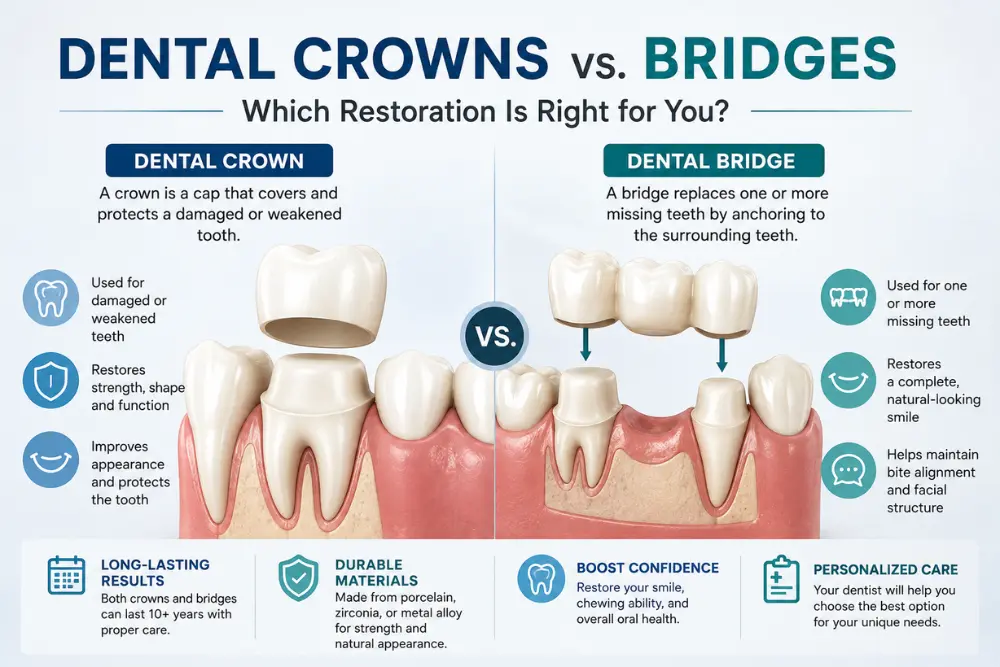
A dental crown is a custom-shaped cap that fits directly over an existing tooth. Think of it as a full-coverage shell, made from porcelain, zirconia, or a metal alloy, that restores a tooth’s shape, strength, and function after it’s been weakened or damaged. Nothing is replaced. The natural tooth root and structure stay exactly where they are; the crown just protects and rebuilds what’s on top.
Crowns commonly come up after:
- A large cavity that’s too extensive for a filling
- A cracked or fractured tooth
- A root canal, since the treated tooth becomes more brittle afterward and needs protection from everyday biting force
- Years of grinding or wear that have flattened or weakened a tooth
- A tooth that’s simply misshapen or discolored and needs a cosmetic rebuild
Crowns also show up in restorations that aren’t strictly about a single damaged tooth. They’re what sits on top of a dental implant post to create a natural-looking replacement tooth, and they’re the anchor points that hold a bridge in place, which is exactly where the next section picks up.
What Is a Dental Bridge?
A dental bridge does something a crown alone can’t: it fills the actual gap left by one or more missing teeth. A traditional bridge uses two crowns, placed on the healthy teeth on either side of the gap, to anchor a false tooth (or several) in between. The whole structure is fixed in place, not removable, and it’s designed to blend in with your bite and your smile.
There’s more than one way to build a bridge:
- Traditional bridge—the most common setup: crowns on both neighboring teeth support a false tooth between them.
- Cantilever bridge—anchored by a crown on just one side, used when there’s only one natural tooth next to the gap.
- Maryland bridge—a metal or porcelain framework bonded to the back of neighboring teeth instead of full crowns, often used for front teeth.
- Implant-supported bridge—instead of relying on your natural teeth as anchors, the bridge attaches to dental implants, which is usually the better route when multiple teeth in a row are missing.
Beyond filling the visible gap, a bridge does real functional work. It helps you chew and speak normally again, keeps your bite balanced so surrounding teeth don’t shift out of place, and helps maintain the shape of your face by supporting the structures a missing tooth would otherwise leave unsupported.
Crown or Bridge? The Core Difference
Here’s the distinction that actually matters: a crown treats a tooth. A bridge replaces one.
If your natural tooth is still there but compromised, cracked, decayed, weakened after a root canal, or worn down, a crown is almost always the answer. There’s nothing to replace, just something to protect and rebuild.
If the tooth is already gone or needs to come out, a crown by itself doesn’t solve anything, because there’s no tooth left to cap. That’s a bridge situation (or, depending on your bone health and how many teeth are missing, a candidate for implant-supported options).
Where it gets more nuanced is when a bridge is on the table: your dentist still has to evaluate the health of the teeth that would anchor it, since a traditional bridge requires shaping those neighboring teeth down to receive crowns of their own. If those teeth aren’t strong candidates, or if you’d rather not alter healthy teeth to support a bridge, an implant-supported bridge or a single dental implant may be worth discussing instead.
Comparing Crowns and Bridges Side by Side
| Dental Crown | Dental Bridge | |
| What it addresses | A single damaged, weakened, or decayed tooth | One or more missing teeth |
| Involves neighboring teeth? | No | Usually yes (unless implant-supported). |
| Common triggers | Large cavities, cracks, root canals, wear, cosmetic reshaping | Tooth loss from decay, injury, or extraction |
| Materials | Porcelain, zirconia, or metal alloy | Porcelain or zirconia, often matched to a crown-anchored frame |
| Adjustment period | Minimal; the tooth’s shape is restored, not replaced. | Mild sensitivity or soreness for a few days is normal, along with some bite adjustment. |
How Long Do Crowns and Bridges Last?
Both restorations are built to be long-term solutions rather than quick fixes. With reasonable care, regular checkups, and good oral hygiene, both crowns and bridges commonly hold up for well over a decade. Zirconia in particular offers a strong balance of durability and a natural appearance, which is part of why it’s used across both crowns and bridges. Metal alloy crowns, while less common cosmetically, remain some of the most durable options for molars that take on heavy chewing force.
What actually shortens the lifespan of either restoration is usually the same handful of things: teeth grinding left untreated, poor hygiene around the margins, or skipping the follow-up exams that catch small issues before they undermine the whole restoration.
Recovery: What to Expect After Each Procedure
Neither procedure tends to be as uncomfortable as people expect going in. For a crown, the tooth is numbed, reshaped, and fitted, and most patients report little to no pain once the numbness wears off. For a bridge, mild sensitivity to hot and cold, some soreness around the gums, and a short adjustment period for your bite are all normal and typically fade within about a week. Most patients return to their normal routine the same day for either procedure.
Which Restoration Is Right for You?
If you’re still weighing crown vs. bridge, a few questions tend to clarify things fast:
- Is the tooth still there? If yes, and it’s damaged rather than missing, you’re likely looking at a crown.
- Is a tooth already missing or about to be extracted? That points toward a bridge, or possibly an implant-supported option depending on how many teeth are affected.
- How healthy are the neighboring teeth? Strong, stable teeth on either side of a gap make a traditional bridge more viable. If those teeth are already compromised, an implant-supported bridge may be the better long-term choice.
- Are multiple teeth missing in a row? Implant-supported bridges tend to hold up better than a single long traditional bridge spanning several teeth.
None of these questions have a one-size-fits-all answer, which is exactly why an exam matters more than a general guide ever can.
Get a Clear Answer for Your Smile
Reading about crowns and bridges only gets you so far. The right call depends on which tooth is involved, how much natural structure is left, and what your bite and jawbone look like up close. At Eagle Falls Dentistry, our team uses digital scanning and an in-house lab to design and fit both crowns and bridges with a precise, natural-looking result, without sending your restoration out to an outside lab you’ll never see.
If you’re not sure which option fits your situation, that’s a normal place to start. Schedule an appointment, and we’ll walk you through it, or contact us with any questions first. You can also learn more about who we are on our About Us page.
Frequently Asked Questions
Is a crown or a bridge better for a missing tooth?
A crown alone can’t replace a missing tooth, since it fits over an existing tooth rather than filling a gap. If a tooth is missing, a bridge (or an implant-supported option) is the appropriate restoration.
Can a crown be used to support a bridge?
Yes. In a traditional bridge, crowns are placed on the healthy teeth on either side of the gap, and those crowns anchor the false tooth in between.
How long do dental crowns and bridges typically last?
With good oral hygiene and regular dental visits, both crowns and bridges commonly last well over ten years. Materials like zirconia offer a strong combination of durability and a natural appearance.
Does getting a crown or bridge hurt?
Most patients report little to no pain during either procedure since the area is numbed beforehand. Afterward, some mild sensitivity or soreness for a few days is normal, especially with a bridge, and it typically resolves within a week.
What are crowns and bridges made of?
Both are commonly made from porcelain, zirconia, or metal alloy. Porcelain and zirconia are popular for their natural appearance, especially on front teeth, while metal alloy is valued for its durability on molars that handle heavy chewing forces.